
writing

What a decade of writing for one CEO taught me

This was true thought leadership -- the kind that was never intended to become another cog inside a sales funnel

For nearly a decade, I wrote perspectives and opinions for a CEO – what the business world calls thought leadership. This is what it looked like:

Each month, the CEO of a privately held services company gathered a hand-picked team of trusted professionals to discuss and debate issues – what’s trending, what’s around the corner, what’s being overlooked, what’s is being misrepresented, and what matters to her company’s audience.

One of us would be charged with drafting the perspective, and occasionally two of us would take a crack at the same topic to examine two different approaches.

We didn’t always agree but we never failed to uncover a truthful perspective, something to say with conviction that we hadn’t heard articulated. The process forced us to think more deeply about what was happening in and around our work, and what clients might find valuable as they wrestled with their own work.

Then we revised, edited, and edited some more before putting it into the world.

Always to an email list first, then to the social feeds.

What came next was the remarkable part.

“How do you know this works?”

It’s the question everyone asks. The response the CEO gave wasn’t what anyone on her team expected. It was atypical of the work-and-response rhythms of client work.     

In that decade of writing, not once did anyone bring analytics to our meetings. Not. Once. And nobody asked for them. The extent of our group’s awareness of “effectiveness” was in the earliest days, confirming emails were sent, noticing an unopened rate to consider a second send, and then making adjustments to dead emails or unsubscribes, which we rare.

Instead, our time together was intentional, focused on mapping and pressure-testing the next set of ideas. That was the important thing – thinking through issues and perspectives that would benefit clients.

In time, it was as though the written content became a secondary byproduct of our robust dialogue, strengthening our perspectives and resolve on key issues.  

Yet the questions from the outside persisted – how do you know this works? – the CEO’s answer was unexpected and refreshing. She said plainly – I don’t know.

And by I don’t know, she meant that she didn’t know what the analytics were, even though she could access them.

That data, if she chose to trust the numbers, easily could’ve killed our work early on.

So why did she persist for a decade?


It became personal

Here’s the thing — she experienced something more valuable than numbers and percentages could reveal.

Before we developed a cadence or monthly expectation among her audience, her peers in the c-suite we responding – first to the to the listserv email, and then to her personal inbox, providing affirming comments, their own thoughts, and occasional pushback, which she welcomed and responded to thoughtfully. At meetings, events, and galas, leaders would tell her they read her latest perspective.

She would share the written comments, unedited, with her hand-picked team. These were supposedly busy executives who didn’t have time to read monthly thought leadership, let alone respond to it.   

It was the only metric that mattered, her tangible proof this was valuable to others, revealing itself in an email, a comment on a client call, a random encounter out in public. It became about personal engagement: her thoughts, their reactions, and ongoing dialogue.

She would openly admit there was no conclusive proof that any of it translated to a specific piece of new work. But she knew it put her top of mind among her audience, creating recall when they bumped into similar issues she’d already wrestled with and shared.  

We didn’t check a thought leadership box with expectation of what would happen the following week or month. We were coming together to challenge ourselves, putting a stake in the ground on what we thought, and sharing our own wrestling match with others where she had the final say on what she believed and attached to her name.

This was true thought leadership — the kind that was never intended to become another cog inside a sales funnel.

Instead, we created authority through the candid and consistent work of thinking through hard issues so that when people needed perspective or expertise, they knew where to turn. She was adamant that we would not turn this exercise into a blatant sales pitch.


What I carry forward

I was an outsider this CEO trusted. I wish I could pinpoint the initial why of that trust, but I worked hard to maintain it, mainly by questioning, pushing, and presenting other perspectives. Sometimes my arguments could shift her lens. Often it galvanized her original thinking and views, spurring language for us in how to defend it.

In retrospect, that decade-long assignment was one of my favorites. And it led to opportunities to work with her and her team in other ways. That’s what trust does.

It also sharpened my thinking and counsel to clients on what I see as effective thought leadership. I believe it has four essential components.


1. Understand the commitment. I’ve worked on several multi-year campaigns with clients. I’ve also had just as many stall after a few months because they expected thought leadership to do their sales work for them. Knowing what you’re committing to – creating authority, not sales conversion – determines if you have the stamina for the work and its intent. Commit to showing up and see what emerges. 


2. Make it a collaborate effort. Working in a small collaborative of trusted thinkers helps to pressure-test every angle and find your unique position. Even when you think you have great ideas, allowing others you trust to poke at it to see how it holds up before writing is essential. Find the people you trust with your ideas and ask them to challenge it and to show you other points of view over your own bias. This is perhaps the most valuable part of thought leadership.  


3. Have courage. You must convey a distinctive point of view. Regurgitating what others have said is neither leadership, nor is it your unique thinking. Having courage to address hard things and experiences, with resolve and empathy, is what makes you memorable. 


4. Play the long game. Authority and trust aren’t handed out freely. They are earned over time when reliability and relatability converge in the reader’s mind. That said, the practice of gathering for deep thinking and idea sparring forges discipline and defines a path forward, becoming as important as any written product. Give it six months to a year, minimum, and listen closely. Watch your trusted team grow in confidence.


That 10-year assignment didn’t feel like a decade of work. It felt like fun that went way too fast. And when the work is fun and valuable to others, you’re on to something.
The hard way differentiation happens

If there's one thing I've learned in the branding / marketing / messaging space over the years it's this:


An excessive amount of time gets spent on how orgs position what they do, concocting the exact blend of words that seem novel in an attempt to say it unlike anyone else is doing it... while little time is spent scrutinizing how "it" gets done and why.


Differentiation doesn't happen as a result of flowery, expertise-driven language or prettier pictures.


It comes by articulating what you do simply, plainly, clearly, unmistakably --and offering it as an accurate reflection of the lived experience.


[ ** side note: people who say they want to create something "out of the box" are not the customer. They are people who have tired of their existing efforts that must not be delivering results, which triggers the desire for more extreme changes ** ]


The perceived hard thing (differentiation) becomes an elusive treasure hunt... while ignoring the obvious thing (clarity and accuracy) because they haven't defined it or see it as too easy to be made so simple (in reality, this is hard).


I liken this to the Kerouac quote:

"One day I will find the right words, and they will be simple."


Until then, many will continue to do a hard thing -- using too many of the wrong words and making things more complicated than they need to be.


It gets even harder when dollars are put behind those words that fail to build trust and move the needle.


And in my experience, that's where the pursuit of simple clarity and accuracy begins.

When your chosen words lose their meaning and intent

Two questions we are not asking ourselves and taking seriously enough:

·        What happens when our language choices lose their meaning?

·        What’s at stake when we rely on vague or overused language? 

As an outcome of our autopilot content creation, here’s that what I think happens: audiences gloss over it, they apply their own meaning or definition to worn-out words, or worse, they dismiss it — and you.  

I believe this happens often, especially when we try too hard to sound smart rather than communicate clearly. And I say that as an audience member and a writer who must fight against autopilot smarts.  

So I’ll ask – what does this business language say to you:

-- Innovation

-- Transformational

-- Brand

-- Speed / Acceleration

-- Strategy

-- Next

You’ll have definitions that differ from mine – and possibly your audience (I have three definitions for each – precise, generic and negative).

When people read these words in context of your content churn, expect that they will apply their definitions accordingly. I do, and I think you probably do, too.

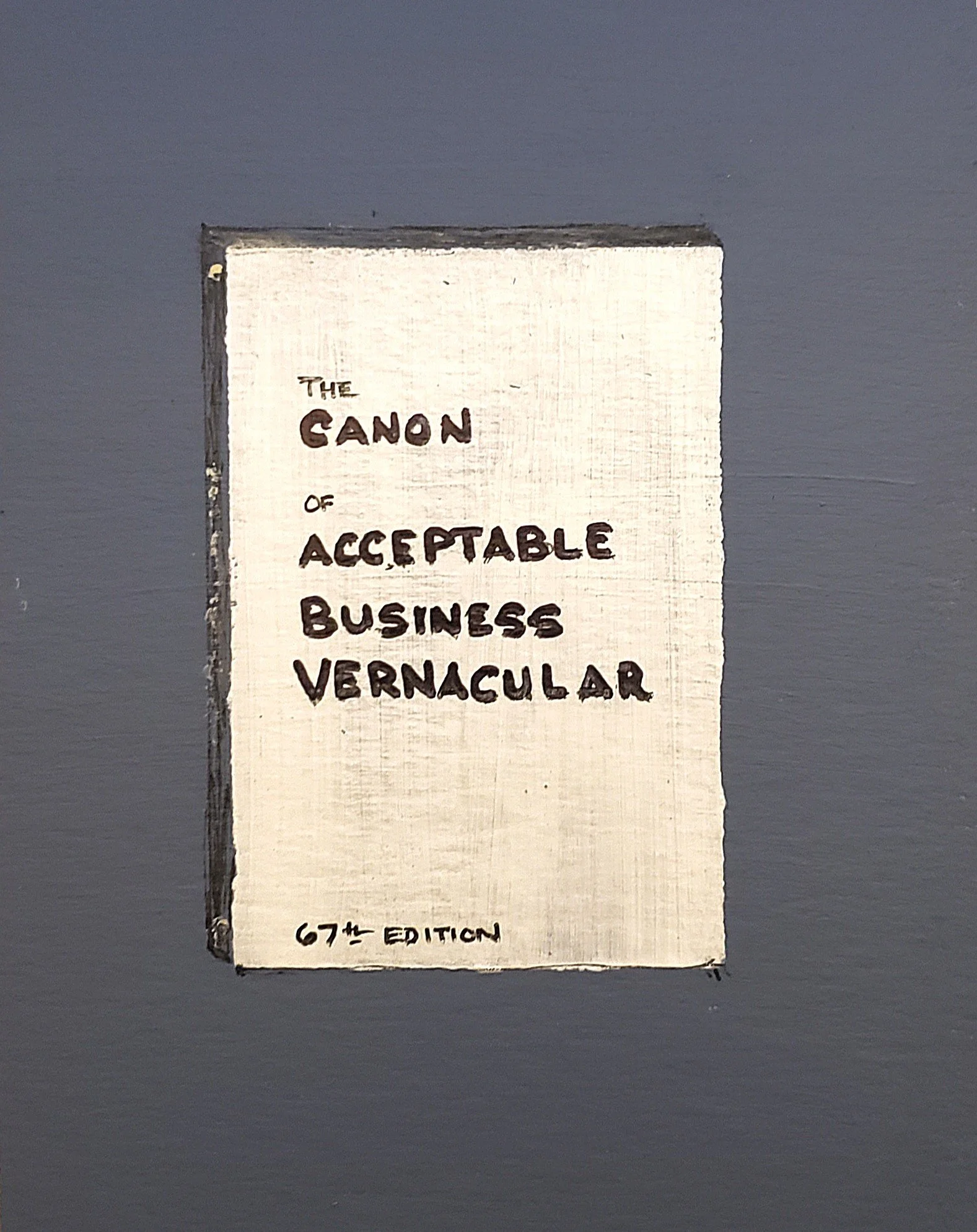
I put these once well-intended words into what I call The Canon of Acceptable Business Vernacular, language that is predictable, rudderless, highly overused and often intentionally vague — the opposite of what should be conveyed, of having distinction and uniqueness that everyone claims.

You know many of the Canon’s entries — formerly known as “buzzwords” at the height of their overuse. Eventually they cool down and become part of the Canon, awaiting resurrection from someone who doesn’t know quite what to say.

But the Canon doesn’t make you or your writing any smarter. Rather, audiences recognize it as business-speak void of the substance and clarity they crave.

And here’s the real danger:

When you turn to the Canon and expect it to do the heavy lifting, you forfeit clarity and meaning.   

When you use the Canon's opaque words by default without testing, asking others and getting clear about what you mean, your words lose their value.

Standing out isn’t about fitting in with a vague vernacular and trying to look or sound the part. It’s about giving audiences a reason to believe because you left no doubt.     

As I see it, we outsourced much of our thinking and language a long time ago by applying so-called “best practices” without asking critical questions about meaning and intent (unless, of course, the strategy is a cut-and-paste and hope-for-the-best approach, which is not a wise strategy and kinda feels like generative AI).   

Sure, it’ll take some deeper thinking and iteration – which will require a bit more time – even as you "accelerate at speed toward the next brand innovation breakthrough that will transform lives." But that’s also the point.

Which brings me to this old trope: Mean what you say and say what you mean.

While you might find it cliché, you’ll do a lot worse if you choose to ignore its simple genius.  

The most important part of writing isn't the writing


I question everything I write.

Until I don’t.


That doesn’t mean I believe my drafts evolve into perfection.

Truth is I haven’t come close to writing the perfect piece, ever.


But what I’ve managed to learn over a few decades of writing is this:

The most important part of writing

is questioning and thinking about

what you just wrote.


This is the writer’s contemplative work that demands unmerciful scrutiny:

  • Is this really what you mean?

  • Will it resonate with the audience?

  • Did you use a helpful example or accurate analogy?

  • Did you allow jargon to slip in?

  • Can you say this differently but better, quicker, more human and conversational?

  • Is it reflective of the brand or individual you’re writing for?

  • Would you want to read this?

  • Does it educate or challenge what you think?

  • Does it make you want to take action?


Here’s an accepted truth:

Anyone can write and putting words on paper or a screen is easy.

But not everyone is a writer – and that’s okay and also acceptable. Not everyone is an engineer either. Which is why it’s helpful for non-writers to understand how writers do what they do.  


Writing (the process) doesn’t look like

writing (the act) at all.

Writing is rooted in everything that is simmering before the first words are hammered out, after the first draft –  and second, third or seventh – or however many are required until you land on a draft worthy of being final.

Writing includes thinking, mulling, stewing, questioning, arguing with yourself, walking away and letting first words calcify, returning to test if they are strong or brittle, tearing elements down and rebuilding.

It looks more like sculpting than writing. That’s because it is art.

Writing also involves letting someone with zero subject matter expertise read your draft to find out if they can follow it, to see if it makes sense even if they don’t know the technical details. Because simplicity outperforms the bravado of expert posturing. Which is to say…


Good writing is hard.

It is never automatic, and never a given.

Writing something good, once, is in no way a guarantee that your next thing will be any good. It requires doing the hard work from scratch, all over again with no shortcuts, in hopes that it too might become good.


The myth of great ideas.

Great ideas (epiphanies!) rarely “just happen” in a first draft or any draft. It’s like the fleeing fireworks display in the sky – it’s looks pretty, briefly, followed by hazy residue once the twinkle fades as you await what comes next. Instead, great ideas are the tortoises in these races to the finish line, always plodding a bit slower than we’d like but worth it in the end.

In fact, epiphanies aren’t unexpected, out-of-the-blue thoughts or ideas at all. They emerge when you prune and edit everything that’s been taking up space – in your brain and on the page. In this sense, the epiphany becomes sudden, recognizable clarity as bloated language and jargon get removed.

The great idea emerges after carefully working and examining the entire landscape and finding it has been hiding in plain sight all along.


Good writing is never over.

However, at some point it needs to be ready or complete. Complete means as far as you can take it, as well as you possibly can, with what you know right now. Because a few weeks or months from now you’ll look at what you wrote and find yet another way, possibly a better way to say it (note: when this was first written, generative AI wasn’t near the concern, a crutch, an aide — however you choose to look at it — that it is today).


For people who don’t do a lot of writing, this takes entirely too long.

For writers, there’s always a desire for more time to allow the best ideas and language to emerge and mature. And that’s because writers know what’s at stake, writers know what the right words can unlock.


We’re seeing a lot of written content that feels disposable, unhelpful, noisy [add your descriptor here]. Many want to call it slop.

It feels like fast food: quick, convenient, seemingly necessary, but also lacking. And just like fast food, disposable content feels even less fulfilling after its consumed.

It doesn’t have to be this way.

Even the shortest post can have a powerful impact.

The deception is in how easy it appears (but you know the truth).

Cut yourself some slack.

The process and the action are part of the iterative and final product.

Think it through (ask more Qs and then think some more).

And then write some really good sh*t.


** For the record, I wrote and edited this piece across multiple sittings, challenging myself and what I believe about the process. Nothing comes easy.


*** The photo image is the cover of Steven Pressfield’s book of the same title and is a must read for writers.

Your bespoke, game-changing copy is the problem

photo credit: Greg Rosenke

You lost me at… bespoke.

It's one of many words that, when pressed, organizations don't really mean or embrace.

Words that would rarely, if ever, come up during conversation, let alone a contract negotiation.

Yet there it is... part of the web copy, the pitch deck, and the promo ad.

Not everyone cares about your word choice.
(but some do)

Not everyone sees you borrowing from the competition's vernacular.
(relax, most people don't believe them either)

So keep this in mind:

  • There are few one-of-a-kind hand soaps or social services providers.

  • There are even fewer game-changing law practices or pumpkin patches.

  • And fewer still... bespoke agencies or pest exterminators.

Then ask:

  • What do we do well enough for the ideal customer or client to say, "We could benefit from that"? (we're not even aiming for uniqueness or greatness yet, just relatability to their needs)

If they have to look up bespoke or question your unverifiable claim, they’re likely seeking out the competition next to see if they speak plainly to their pain point.

Make it EASY for people to choose you.

And when it doubt, always simplify.