

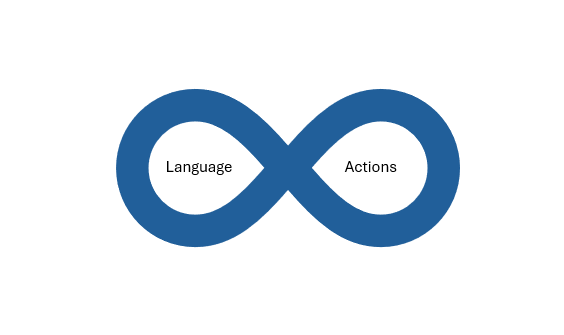
Effective orgs create an intentional mirror reflection:
where language accurately defines brand actions,
and the brand’s actions fully reinforce its sentiments.
It becomes a synchronized infinity loop.
This is the brand in action
long after the “branding” is done.
It is the cementing work of brand reputation.
Lived out, it trades like currency, a gateway to better:
Partnerships. Talent. Loyalty. Market share.
It becomes brand truth. Delivered.
But when your language and actions are out of sync,
when one side doesn’t accurately reflect the other,
the brand narrative becomes
A WORK OF FICTION.
That can be a repellent when people are seeking truth
and something they can believe in -- now more than ever.
The Power of a Strong Brand
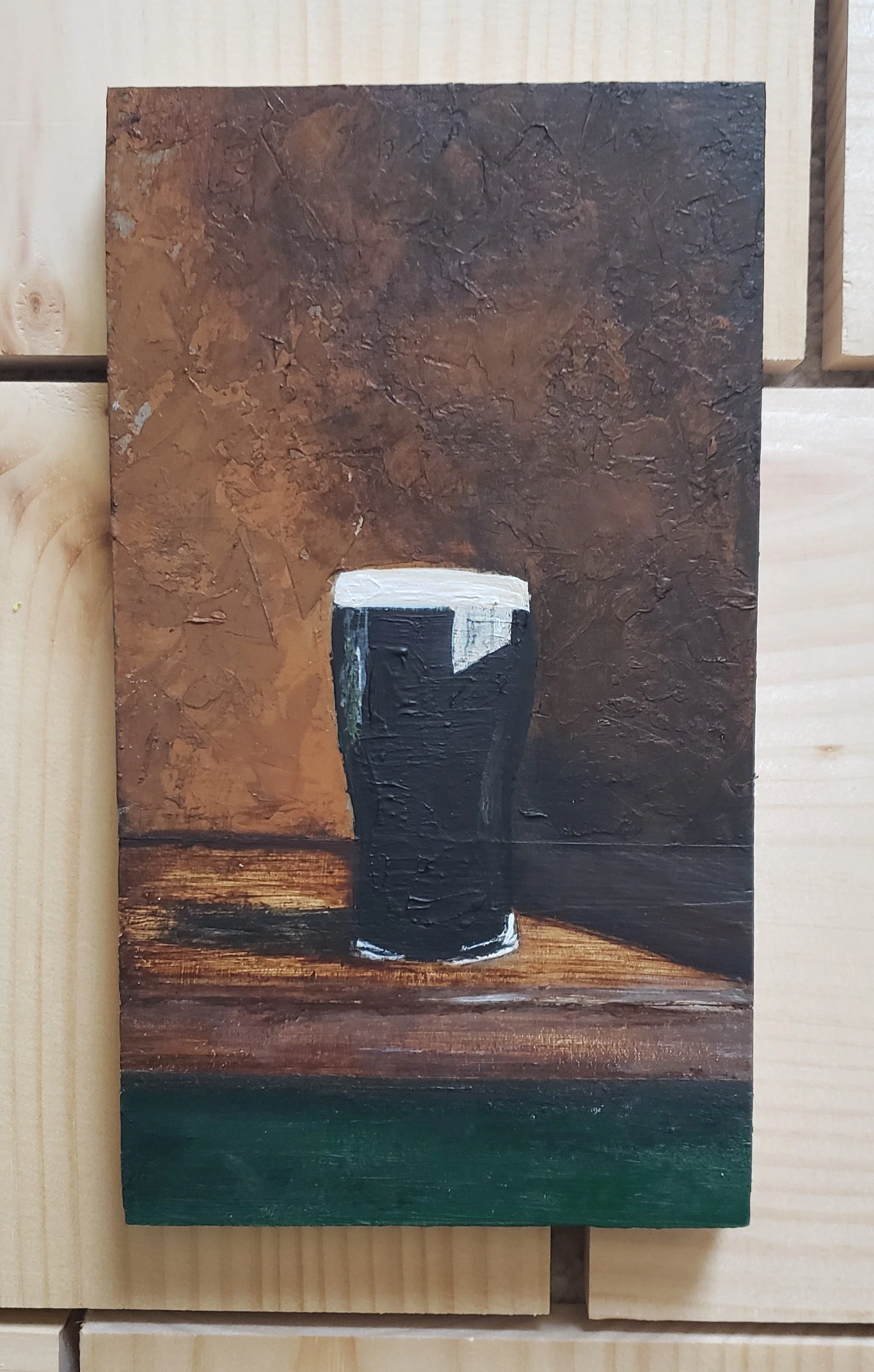
Can you guess this brand?
I recently wrapped up this little painting late at night, deeming it "good enough" before I ruined it by "overoptimizing" it (a reality in all of my work).
I debated one last tweak -- etching the beer's name on the glass -- before calling it quits.
Then I was reminded of the power of strong brands.
***
You already know this beer.
You recognize its color, the thick frothy head, the shape of the glass.
You know what country it comes from.
And whether you personally like it or not, it likely conjures up memories... maybe of a certain day in March, or of a time with friends at the local pub.
This might be the only beer on the planet that is unmistakable at first glance -- and without a labeled bottle or can nearby.
Can you say that about your favorite pilsner or IPA? I can't.
***
There's plenty of stouts and porters to choose from. And even if this were a different beer, your mind is already locked in on this brand. It lives rent free in your head each time you see it.
That association was built with careful intention, and delivered one pour, one pint glass at time.
That's a strong brand at work -- even when the logo is absent.
Cheers!
(Props to my near 80-year-old neighbor Phil who kindly squares off discarded wood scraps from his workshop and gives them to me as canvases to support my painting habit)
The hard way differentiation happens
If there's one thing I've learned in the branding / marketing / messaging space over the years it's this:
An excessive amount of time gets spent on how orgs position what they do, concocting the exact blend of words that seem novel in an attempt to say it unlike anyone else is doing it... while little time is spent scrutinizing how "it" gets done and why.
Differentiation doesn't happen as a result of flowery, expertise-driven language or prettier pictures.
It comes by articulating what you do simply, plainly, clearly, unmistakably --and offering it as an accurate reflection of the lived experience.
[ ** side note: people who say they want to create something "out of the box" are not the customer. They are people who have tired of their existing efforts that must not be delivering results, which triggers the desire for more extreme changes ** ]
The perceived hard thing (differentiation) becomes an elusive treasure hunt... while ignoring the obvious thing (clarity and accuracy) because they haven't defined it or see it as too easy to be made so simple (in reality, this is hard).
I liken this to the Kerouac quote:
"One day I will find the right words, and they will be simple."
Until then, many will continue to do a hard thing -- using too many of the wrong words and making things more complicated than they need to be.
It gets even harder when dollars are put behind those words that fail to build trust and move the needle.
And in my experience, that's where the pursuit of simple clarity and accuracy begins.
Your bespoke, game-changing copy is the problem

photo credit: Greg Rosenke
You lost me at… bespoke.
It's one of many words that, when pressed, organizations don't really mean or embrace.
Words that would rarely, if ever, come up during conversation, let alone a contract negotiation.
Yet there it is... part of the web copy, the pitch deck, and the promo ad.
Not everyone cares about your word choice.
(but some do)
Not everyone sees you borrowing from the competition's vernacular.
(relax, most people don't believe them either)
So keep this in mind:
There are few one-of-a-kind hand soaps or social services providers.
There are even fewer game-changing law practices or pumpkin patches.
And fewer still... bespoke agencies or pest exterminators.
Then ask:
What do we do well enough for the ideal customer or client to say, "We could benefit from that"? (we're not even aiming for uniqueness or greatness yet, just relatability to their needs)
If they have to look up bespoke or question your unverifiable claim, they’re likely seeking out the competition next to see if they speak plainly to their pain point.
Make it EASY for people to choose you.
And when it doubt, always simplify.
Everyone wants creativity & innovation; few have the required patience

Photo credit: Duane Mendes via unsplash
I read a sponsored headline on LinkedIn recently that said – The Opposite of Inconvenience Is Innovation.
(Not quite true and it resonates as an AI headline, but I’ll withhold judgment).
Then you had to “unlock” their gated, six-carousel slide deck to understand their point.
To that I’d say: unlocking gated material on LinkedIn is the opposite of convenient.
Fellow creative and copywriter Mike Roe recently shared an article on the death of creativity. I was drawn to a particular claim about the near-uselessness of three-fourths of the brands paraded in front of us, and how we wouldn’t miss them if they disappeared.
Think about that: the vast majority of companies/brands are easily forgotten, including yours.
The premise here is that we’ve killed creativity — meaning we aren’t creating anything memorable — in lieu of being efficient with time and speed at the lowest possible cost.
That, friends, is how we end up with headlines and campaigns promoting products like the one above. And it is also how they falter because they fail to entice, and in turn expect something from us long before earning our trust.
What might’ve enticed me to open this sponsored campaign and discover their offering? Simple:
1. Don’t lock your content on LinkedIn (be generous, be a thought sharer)
2. Entice us with stories/snippets that will resonate, something like…
Opportunities are created more than they are granted.
Your team keeps looking for opportunities, but when was the last time you granted them time to create something that turned heads? Got people talking? Shook the industry?
Here’s the rub: creating takes time. This can feel wildly inconvenient. It is far from instantaneous. But it is worth it. Just ask the computer maker not named Dell, or Gateway, or Compaq, who put a jukebox in the palm of your hand, and gave you a phone that still functioned like a phone, but became your essential life assistant.
Innovation isn’t doing what you know how to do a little differently. That’s called chasing the market leader. And, whoa, talk about inconvenient.
Remember — you have a choice: to either keep looking for opportunities — or start creating them.
To be fair, maybe this was the same kind of sponsored content the company gated, offering me to dive deeper into their offering, their own unique solution.
But I’ll never know – because I wasn’t compelled to look.
Think of it this way:
How many times has your audience been dismissive or not compelled to look because the creative was rushed, roadblocks to engagement we intentionally set for the sake of data, and meeting the artificial deadline prevailed over doing the best possible work with a better chance of resonating? Have any of us ever been guilty of such a thing?
When we rush creativity (the very thing that leads to innovative ideas) we take away the power of its potential.
We’ve been conditioned to “box it up” and promise what it will do in terms of metrics, sales, and how it measures up on spreadsheet – literally putting it in a box. When we do this, we have succumbed to the antithesis of creativity. Everything begins to look the same. No wonder three-fourths of brands are forgettable.
We neuter creativity before it has a chance do its intended thing – which is to wow people, stop them in their tracks, and get them talking.
And yet that is precisely what every company says it’s pursuing, but typically with poor copy that falls on deaf ears.